A national service, hidden behind a spreadsheet
The Restart Scheme is one of the government's Contracted Provisions, courses that help people back into work. It launched as an MVP in 2019 and did well enough to keep getting extended year after year, but the referral process barely changed. To make a referral, a work coach had to leave the Universal Credit live service, log into a separate tool called Find & Refer, and copy details back and forth between the two.
All of this happened live, on a phone call, while the coach sat between a claimant and a provision provider. And they had a strict 20-minute slot to do it in. The experienced coaches had found their workarounds. Newer ones struggled, left tasks for later, and stretched their day out to keep up.
This data is sensitive, so every screen shown here uses dummy information in a preview environment.
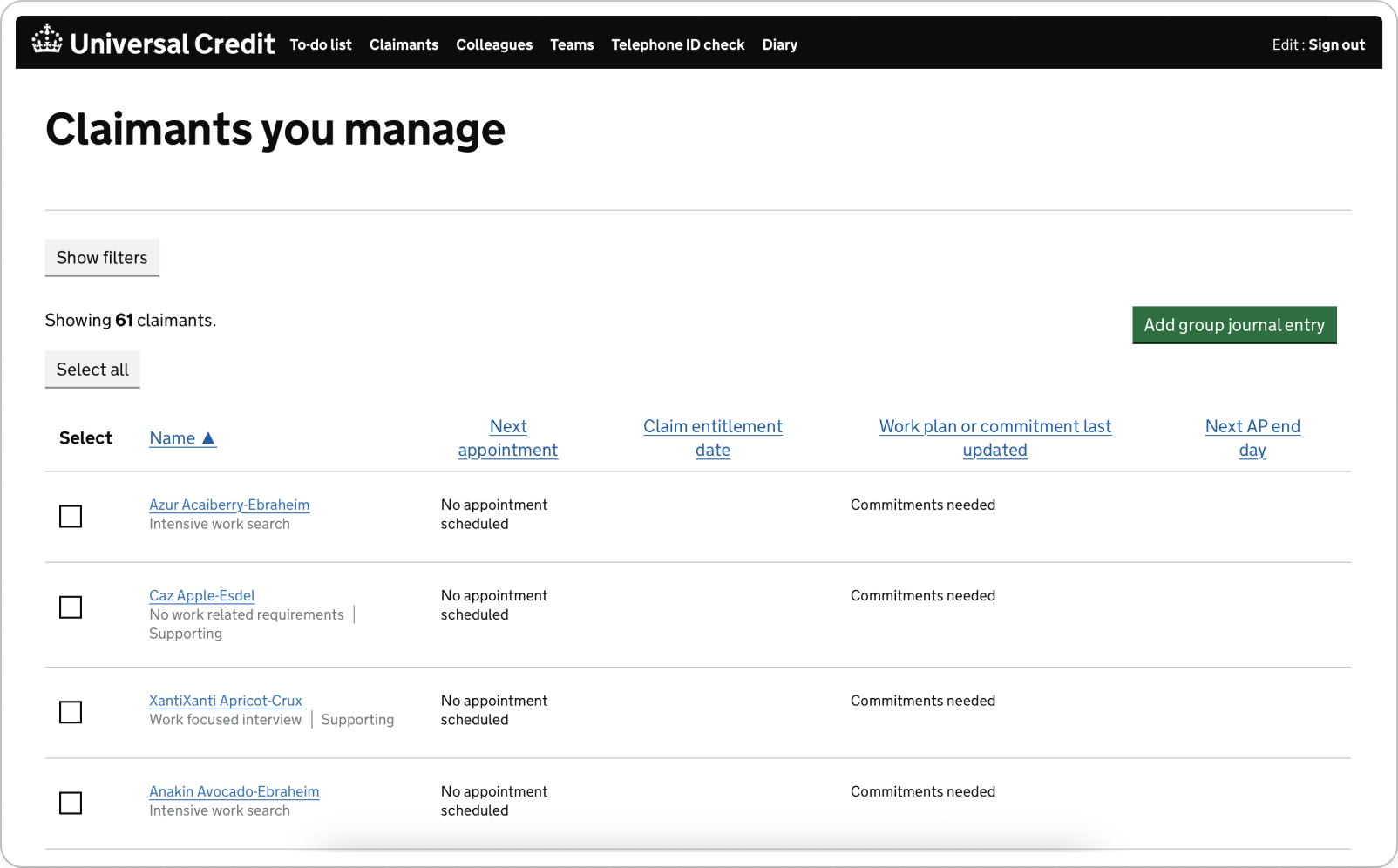
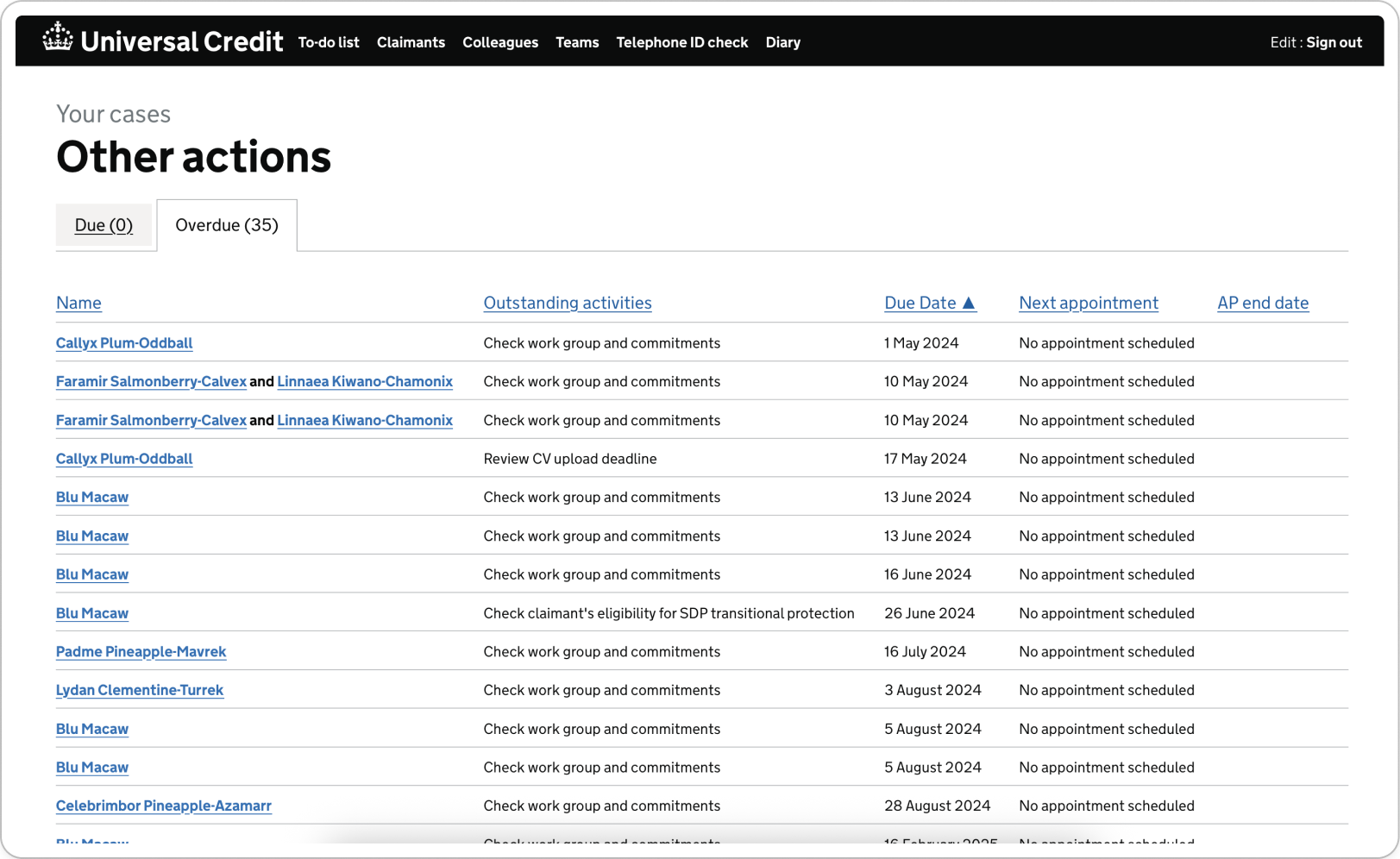
A referral meant leaving the live service, logging into another system, and copy-pasting data that already existed. A swivel chair, mid-call.
Finding the pain worth fixing
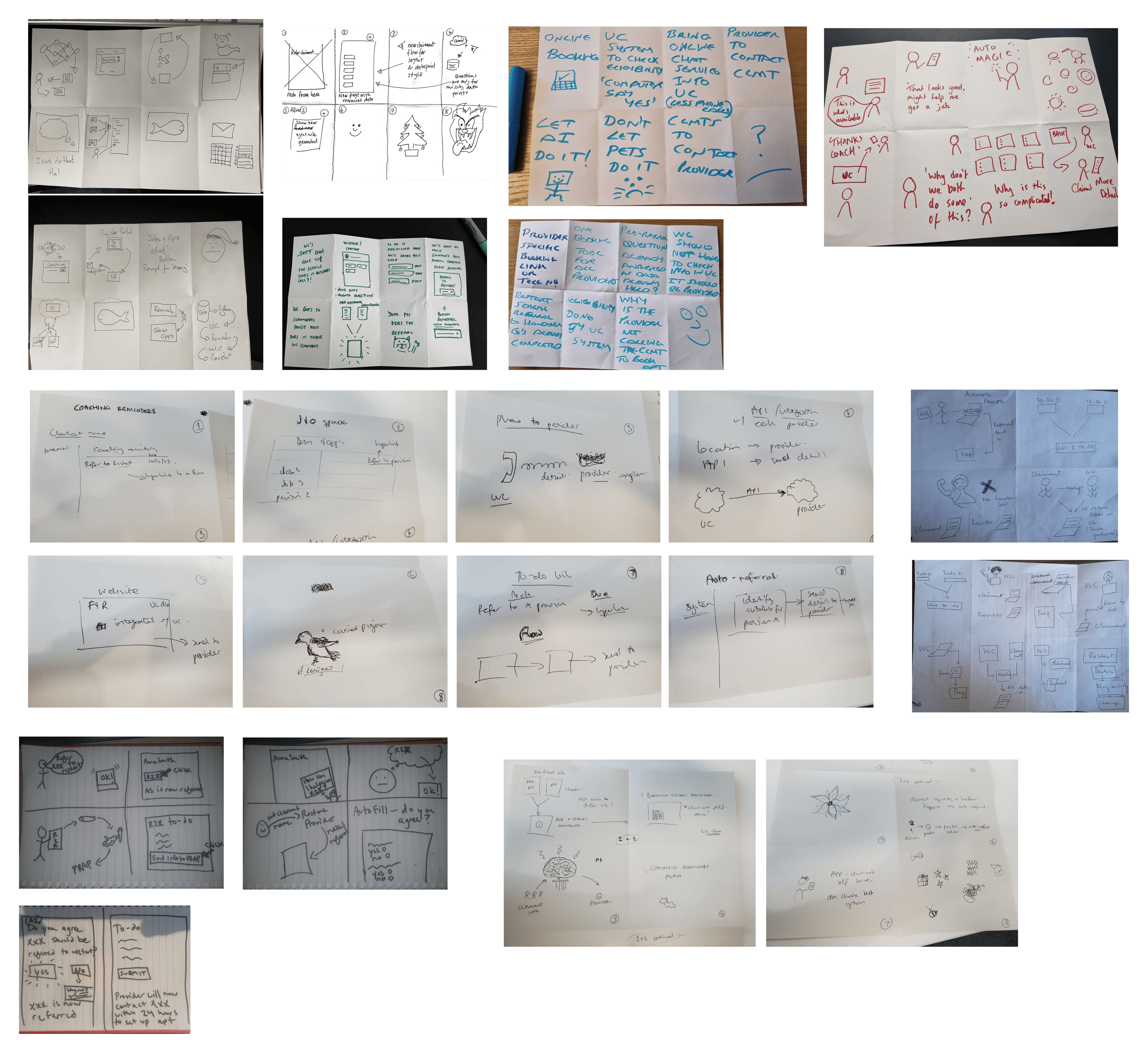
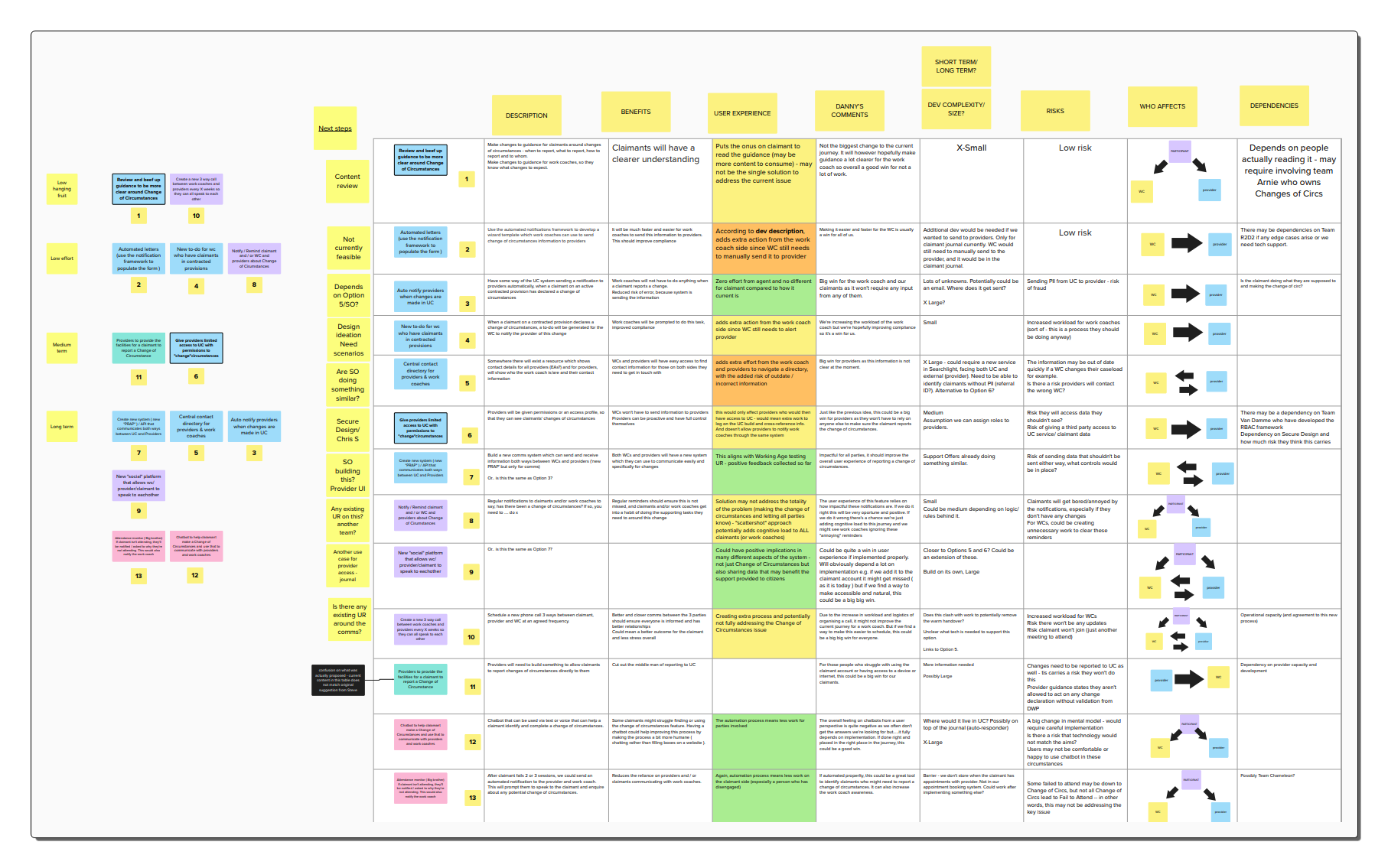
I ran an in-person workshop with the whole team to map out pain points, user needs and assumptions, then a round of Crazy 8s to get ideas flowing. We voted on them, then sat down with our Business Analysts, Delivery Manager, Product Manager and Tech Lead to weigh each one against feasibility and the timeline we'd agreed with ministers and policy.
Fixing everything would have taken years, so we made a deliberate, honest cut and focused on three things:
- Take out the biggest time-sinks and lower the cognitive load, so coaches could stay present in the conversation.
- Build a single shared API so Universal Credit and Find & Refer could talk to each other directly.
- Retire the Find & Refer front end for good, so coaches could manage referrals inside the service they already live in.
Accessibility built in from the start
We turned those user needs into clear interaction models, with accessibility set as a baseline requirement rather than an afterthought. We kept cognitive load low, made navigation predictable and revealed detail step by step, stuck to recognised GDS components and patterns, and built in WCAG 2.2 AA contrast, keyboard and screen-reader support, touch-target sizing, error prevention and proper semantic structure.
Making it an explicit step from day one kept the whole team bought in, so it never got lost in the implementation minefield where accessibility usually gets quietly dropped.
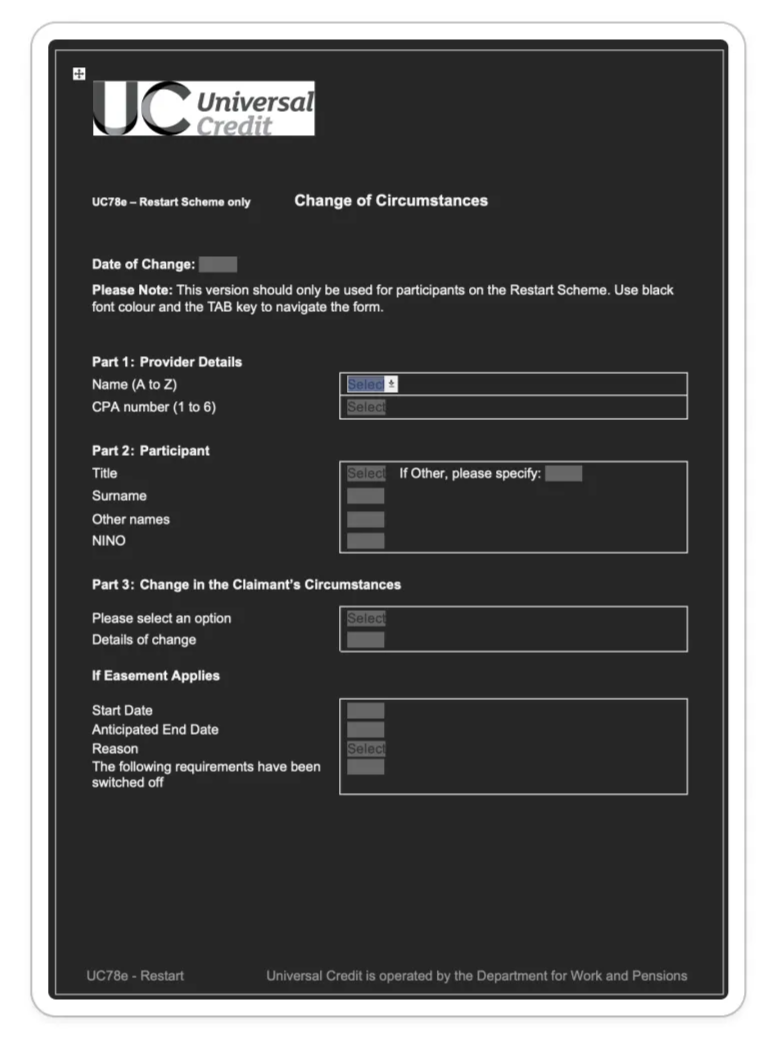
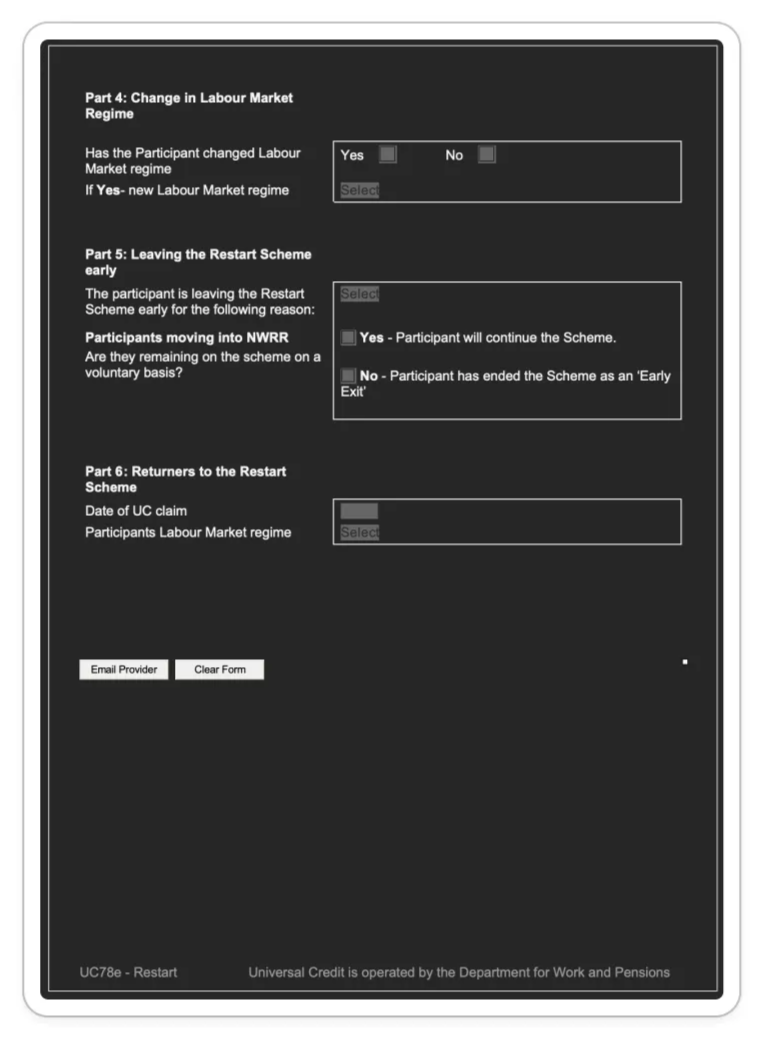
The UC78e form, digitised
We started with the clearest win. The UC78e is essential for getting a claimant onto a provision, and it lived as an Excel sheet that meant a lot of copy-pasting out of the live service. We worked out exactly what the form actually needed, stripped anything we could pull straight from live data, and teamed up with another squad building a new universal letter and notification framework to test the flow.
Full automation wasn't on the table yet, but the digitised version tested well. Work coaches told us it would save them real time, and asked for even more of it, which we logged for a later iteration.
No more swivel chair
The headline change: making a referral without ever leaving Universal Credit. This was as much a collaboration with the dev team as a design job. We ran workshops to agree exactly what data we genuinely needed to make a referral, cut everything else, then mapped the new journey into the existing "to-do".
There were real compromises on both sides. The Universal Credit tech stack forced things like asynchronous calls to Find & Refer, for one. But we tested through several rounds of research with work coaches and iterated our way there. We also surfaced referral management in the Jobs & Opportunities page, an existing but barely-used area that saw a big jump in use once the new functionality landed.
Time given back, at national scale
We set out to save work-coach time, and we did. We looked at success rate, errors and hesitation, but the number we really cared about was time spent on the to-do. We brought the average completion time down from 16 minutes to 14. Two minutes off every referral.
At roughly 25,000 to 30,000 referrals a week, that works out at around 35 to 42 hours saved a week. Somewhere between 1,820 and 2,184 hours a year, right across the country.
The tip of the iceberg
We did what we set out to do, but we were honest with ourselves that we'd "put lipstick on an outdated to-do". Plenty of ideas from that first session are still doable and could genuinely improve the process. Policy and ministers were happy enough with the result to agree to scale the approach to other Provisions. The next project zooms out to look at the whole Provisions journey and build a proper framework for it.